
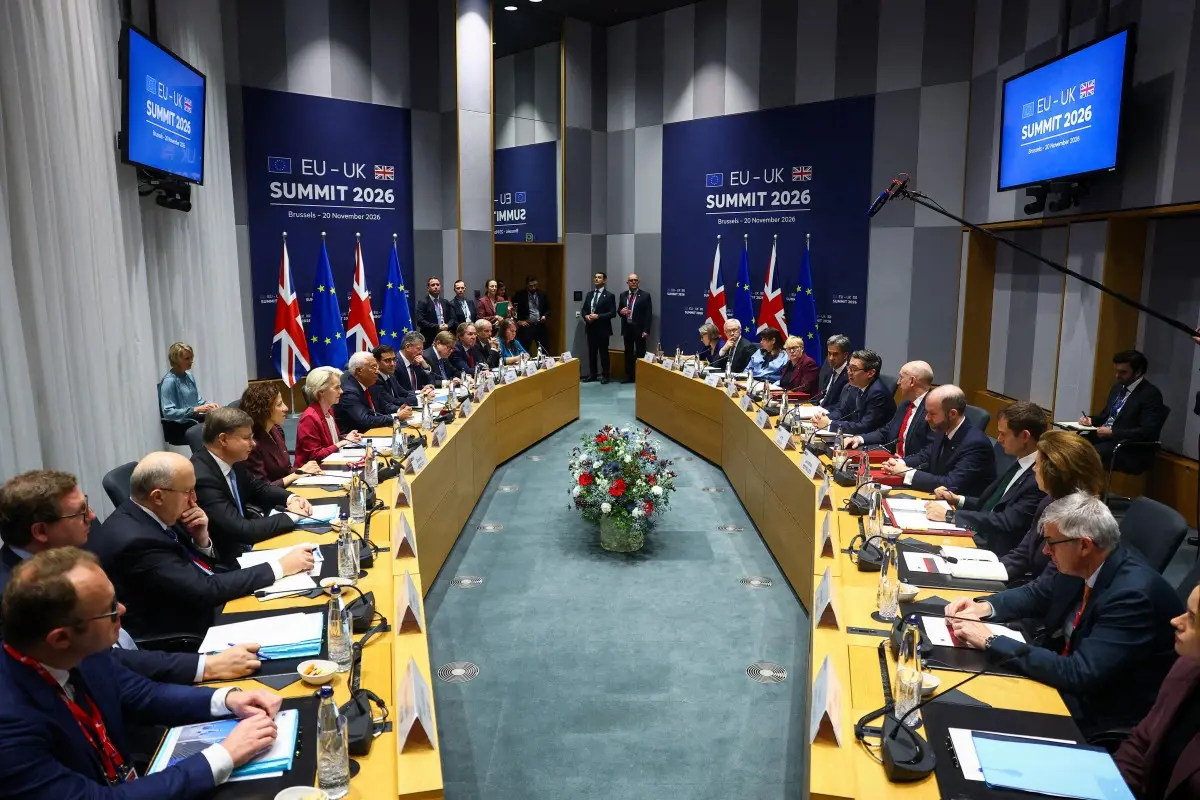
British Prime Minister Andy Burnham met EU chiefs Ursula von der Leyen and Antonio Costa in Brussels on Friday for a summit aimed at resetting ties after the rancorous Brexit years.
The two sides announced several deals and opened the way for further cooperation down the road -- although the 27-nation bloc and London jostled over linking ultimate implementation of the deals to Britain agreeing to cut university fees for EU students.
Food and drink
A "food and drink" deal was announced to cut red tape that has hampered trade since Britain left the European Union.
Britain and the EU will do away with certificates and border checks on food and animal products like cheese and bacon, which London said could add up to £5.1 billion (6.1 billion euros) a year to its economy.
Britain will have to align more closely to EU rules on food safety and animal and plant health -- a bugbear of Brexit supporters.
The British government has had to deny the accord would, for instance, trigger a ban on smoky-flavoured crisps or that marmalade would have to be re-labelled as "citrus marmalade".
Emissions
The two sides agreed to link their emissions-trading schemes. Aimed at tackling climate change, these broadly require polluters to buy allowances for the planet-warming emissions they release.
The deal would see Britain and the EU recognise each other's allowances and exempt goods traded between them from their respective carbon border taxes.
London said the agreement could add up to £3.8 billion a year to the British economy, and spare £6.5 billion worth of steel, aluminium and other industrial exports from additional taxation.
Young people
Brussels has gunned for a deal to allow young people from both sides to live in each other's territory for three years and have European students attend British universities at reduced rates, equal or closer to those paid locally.
This has proved one of the thorniest negotiations as London, under pressure to keep down migration, drove a hard bargain, irritating European counterparts.
After long discussions, the two parties settled on capping the "youth experience scheme" to 100,000 beneficiaries per side per year, according to an EU official.
But no deal was reached on tuition fees, with London and Brussels agreeing only to settle the matter within six months.
The EU has suggested this is critical for it and it is ready to put the breaks on the official signing of the other deals if an agreement is not found.
Electricity
Looking beyond this week's summit, discussions are ongoing for Britain to participate in the European electricity market. Proponents say this would boost energy security and help bring down prices.
Five EU countries, including Germany, the Netherlands and Denmark, argue it would help transform the North Sea region into "the largest clean energy hub in the world", driven by wind power.
Yet, Britain might be asked to pay an "entry fee" to go towards development projects in Europe's less affluent regions. How high a fee is sure to be the source of much wrangling.
Migration
The EU and Britain said they will establish a "Structured Dialogue on migration". A joint summit statement says this will include "engagement with third countries" and "returns to third countries" among other issues.
This comes after Burnham said Britain was following "with interest" a push by EU countries to set up migrant deportation centres outside the bloc.
Germany, Austria, Denmark, Greece and the Netherlands have since announced plans to open one such facility in Rwanda.
Made in Europe
The parties committed to establish formal talks on "economic security" and cooperate on export controls and supply chains, among other things.
The UK is worried about its potential exclusion from EU efforts to boost domestic sectors like cars and defence by forcing companies to buy European if they want public money.
But Brussels is not yet in a position to make or deny concessions, as EU member states and lawmakers are still fiercely debating the final shape the scheme should take.
Comments